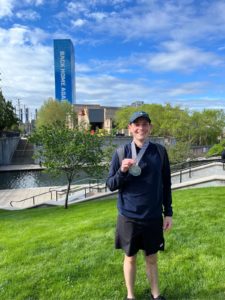
I ran my first marathon in October 2015. It no longer exists.
That’s not entirely true. It does exist, but it’s been changed from what they now call a “full” marathon (the good ol’ 26.2) to a half marathon—just 13.1 miles, which, to be fair, is still plenty of pain for most people.
That’s right. Marathons are so popular right now in the United States that people will run one halfway just to say they ran a (quiet part) half (loud part) MARATHON.¹
It hasn’t always been this way, of course. In the early 1970s, you could just sort of show up the morning of Boston Marathon and run it. Actually, a lot of people did just that. There were qualifying times, even in those early days, but there was also a lot of banditry, or people running the race without officially signing up or paying a registration fee. It was the height of the counterculture movement and people back then were a lot less uptight about the rules. It was easier to allow the bandits to run than it was to try to catch them all.
Fast forward to 2025. These days you can’t even sniff the fresh cut grass at the starting line in Hopkinton without a blazing fast time or a charity bib. Currently, to qualify for the 2026 race as a 45 year old man, the time is 3 hours and 15 minutes. But here’s the sneaky and not altogether fair part: it’s not necessarily enough just to run a marathon faster than the qualifying time. Boston also employs “cut offs,” which is basically like when restaurants charge $18 for a burger but neglect to tell you that fries aren’t included. Then, there’s tax and tip and something called a “cost of living/service fee,” and so pretty soon an $18 burger is really closer to $30 by the time you’re out the door.
Same basic principle here. And the common cause is simply that marathons have become too popular. There are too many people running them. So the good folks at the Boston Athletic Association—and the heads of the other so-called “marathon majors”² around the world—had to improvise. Cut-offs or “buffers,” as they’re also known, allow the organizers to charge a little extra for fries and force you at gunpoint to give more gratuity. (So to speak.)
In 2025, the cut off time for Boston was 6 minutes and 51 seconds, which would mean that for me to be guaranteed a spot on the course next year, I would have to run a marathon in more like 3 hours and 8 minutes, which is (a) highly unlikely, and (b) also assumes that the cut offs for 2026 will stay about the same. (My marathon PR is 3:33. Not too shabby, but nowhere near a BQ³.)
Anyway, enough about cut offs.
As I was saying, my first marathon was called the Indianapolis Marathon, and they ended it the year after I ran it. Probably because of my crappy time.
Just kidding. Here’s the real story.
In 2008, the inaugural Indianapolis Monumental Marathon and Half Marathon was held for the first time, bringing together a small but spirited community of runners who would go on to form the heart of what became Beyond Monumental. Among them was Judy Hasselkus, a self-described “accidental athlete” who finished her first half marathon that year in 2:21:21 and discovered a lifelong affection for the event. Others, like Ted Maple and Indy Runners & Walkers’ own Brian Schuetter, found similar inspiration—Maple returning to running and eventually sharing the race with his son, Schuetter treating it as both a personal challenge and a kind of “family reunion” for the local running community.
Saturday, October 17, 2015 saw the final staging of the old Indianapolis Marathon at Fort Benjamin Harrison—that was my first marathon. I loved the marathon course at Fort Ben. Great swaths of the course took runners nearly out into the corn fields of northeast Indianapolis, just past the Lawrence city limits. There were portions of miles 18-22 where I don’t think I even saw another human being. Beautiful course, and a bit lonely, too. (Then again, marathons are always kind of lonely, especially after Mile 20.)
The fall of 2015 marked the last year with two separate full marathons held in Indianapolis; starting in 2016, the Indy running scene consolidated when the Indianapolis Monumental Marathon acquired the Indianapolis Marathon, turning the old Indianapolis Marathon into a half marathon, now officially called the Indianapolis Half Marathon at Fort Ben. Monumental became the city’s single 26.2-mile race, while the Fort Ben event shifted to a half-marathon and 5K and has stayed that way since. The move was designed to elevate the Monumental’s national profile—it’s already ranked among the top 25 U.S. marathons and draws an estimated $3 million economic impact each year. Both races continue their strong community ties: the Indianapolis Marathon raised more than $600,000 for nonprofits, while the Monumental has contributed over $675,000 toward education and youth fitness.
I know, it’s confusing. And we haven’t even talked about the Indy Mini-Marathon yet, a half marathon run each year on the first Saturday in May under the banner of the 500 Festival.
Over the years, the Monumental has grown from a scrappy hometown race into a world-class event, all while maintaining its warmth, its focus on community and education, and its deeply personal meaning for those who’ve been there since the beginning. For these runners, it’s not simply another marathon among others. Rather, it’s tradition, family, and homecoming rolled into 26.2 miles.
As part of the run up to this fall marathon season, I reached out to a few Indy Runners board members for their sage advice on training for and running the full 26.2 miles.
Here’s an excerpt from an interview with Indy Runners Vice President Tara Cassidy.
What’s one training mistake you made early on that you’ve since learned from?
One of the biggest training mistakes I made early on was trying to do it all alone. I didn’t anticipate how tough some weeks would be, and I quickly realized how much I needed the encouragement and accountability of running partners. Finding the IRW [Indy Runners & Walkers] community has truly changed my life. Having a support crew that shows up for you—on the road, the trail, or even beyond running—has been invaluable. I wish I had found them sooner, but I’m deeply grateful to have them now. Running with others, sharing the struggle, and pushing through the trenches together makes all the difference when training gets tough.
How do you handle the mental and physical challenges of long runs?
The best piece of advice I’d give to someone running their first marathon at Monumental is to truly enjoy the journey. Embrace the training, because that’s where you’ll discover the most about yourself—your grit, your discipline, and your resilience. Stay consistent, especially with your long runs, because they are the foundation of your race-day confidence. And don’t overlook nutrition: practice with gels and hydration strategies ahead of time so there are no surprises. Most importantly, have fun and soak it all in—the miles, the crowd, the energy. It’s an experience you’ll carry with you long after the finish line.
What has running marathons taught you about yourself?
Marathons have shown me that I am capable of far more than I ever imagined. Training requires 12–20 weeks of relentless discipline, consistency, and sacrifice. Crossing the finish line is more than a physical accomplishment—it’s proof that perseverance pays off. Marathons have empowered me to keep showing up, even when the path is tough, and to trust that with resilience and a positive mindset, you will always find your way to the other side.
Longtime Indy Runners board member and accomplished marathoner Brian Cake, who qualified for Boston at the 2023 Monumental Marathon, had this to say about the art (and science) of marathoning:
What’s the single best piece of advice you’d offer to someone running their first marathon at Monumental this year?
Simulate aspects of the pre-race and the race itself during training. Other than running 26.2 miles, try to avoid doing anything new in the few days before and day of the race.
Here are some example things to consider:
- Wear the shoes you plan to wear during the race during at least one long run (preferably 15+ miles). You want to lessen the chance of getting a blister at mile 20.
- Try to get a training run in every type of weather: hot, humid, cold, rainy, windy, etc. Test different clothing combinations. Consider keeping a log of what clothes worked for you during different conditions.
- Test your pre-race nutrition before at least one training run. Mexican food might sound good the day before a race but [will] leave your stomach turning the next morning. You want to know that in advance. I personally prefer a dinner before the race centered on white pasta or rice with some spaghetti sauce, chicken, a modest amount of vegetables, and some sort of bread. Limit your fiber intake to lessen the chance of stomach issues. The morning of the training run, get up early and eat whatever you plan on having race morning.
- Test your in-race nutrition on long training runs. You want to find things your stomach can handle: gels, sports drinks, candy, … Try different flavors because you never know what will sound best late in a race.
- Do some race pace miles in training. If you’re unsure how fast they should be, choose a pace that feels a little slow. Your adrenaline on race day will likely cause you to start faster than expected.
How do you handle the mental and physical challenges of long runs?
Be intentional with your training plan. Increase the distances of your long runs at a reasonable rate – perhaps 1-2 miles per week. The increase is always manageable, and your body gets used to it. A two to three week training taper will help your body recover before the longer race-day increase, e.g., 6.2 miles if your longest training run was 20 miles.
Maybe that’s what keeps me running—the weird, contradictory intimacy of the sport. You’re surrounded by thousands of people, yet you spend most of the time talking to yourself. You go inward to move forward. Somewhere around mile 22, when the roar of the crowd fades and the lower half of your body has basically stopped working, you meet yourself in a way you can’t fake. No algorithm, no app, no smart trainer can do that for you.
And yet, it’s also not a solitary pursuit. Running has its own ecology: training partners, pacers, spectators, volunteers, the friend who texts you “Good luck!” the night before the race. I think that’s why I keep coming back to the Monumental—it captures both the solitude and the solidarity of running. You can run alone, but you can’t do it without others.
Marathoning is an act of optimism disguised as punishment. Nobody signs up for a marathon because it’s convenient. You sign up because you believe that, in some small but meaningful way, the work matters—that persistence still counts for something in a world obsessed with shortcuts. Maybe that’s why the post-pandemic resurgence of marathon running feels so significant: people are running toward connection again, toward endurance, toward life.
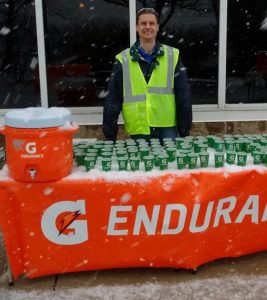
I probably won’t ever qualify for Boston, at least not until I’m in my 90s. But by then, there will be AI bots competing and human-machine hybrids and I just don’t know how I feel about racing against non-human hybrids. And that’s fine. I’ve found my own Boston right here—flat, friendly, unpretentious, and full of people who will hand you a cup of Gatorade like it’s the Eucharist. Every November, the Monumental reminds me why I run: to remember that the body can still do hard things, that community still exists, and that some kinds of exhaustion—earned, honest exhaustion—can feel an awful lot like joy.
So if you’re standing downtown on Washington Street on Saturday, November 8, cowbell in hand, or if you’re out there on the course, lungs burning, legs screaming, don’t forget to look around. We’re all part of the same long, slow, sweaty story.
And that’s pretty monumental.
I’d really love to include as many voices as possible in this series—veterans, first-timers, half-marathoners, Boston qualifiers, and everyone in between. Your experiences are what make our local running community special, and your stories might be exactly what someone else needs to hear at mile 22. So take a few minutes to reflect and write in with your thoughts. Whether it’s a hard-earned lesson, a favorite Monumental memory, or the reason you lace up your shoes in the first place, I want to hear it. Send your responses my way (no need to be formal), and let’s celebrate the miles and the meaning together.
Email me at paulcook@yahoo.com. And, if you enjoyed what you read here, sign up for my newsletter, The Highlight Zone, where I write about politics, higher education, and distance running in the Midwest and elsewhere.
NOTES
1. After the long, wheezing hangover of COVID-era cancellations, 2024 was the year the marathon world finally got its pulse back. Participation actually surpassed pre-pandemic (2019) levels, which is a polite way of saying that a lot of people decided, post-global-crisis, the best way to celebrate being alive was to pay $250 to suffer publicly for 26.2 miles. U.S. marathons saw a 5% bump, topping 432,562 finishers, which suggests not only recovery but a kind of existential resurgence: people running not from something, but for something. True, the numbers still trail the 2014 all-time peak—but with New York and London both setting finisher records in 2024, the pulse of marathoning is coming back.
2. The so-called Marathon Majors—that hallowed pantheon of pavement punishment—consist of Boston, London, Berlin, Chicago, and New York City, with Tokyo added in 2013 to internationalize the suffering and, as of 2025, Sydney joining the club, presumably to give runners one more reason to question their life choices while sweating through a southern hemisphere spring. Finish all six of the originals and you get the “Six Star Medal,” a talismanic piece of hardware that announces, in effect, I have voluntarily spent thousands of dollars and most of my cartilage chasing this very shiny circle.
3. BQ = Boston Qualifier.